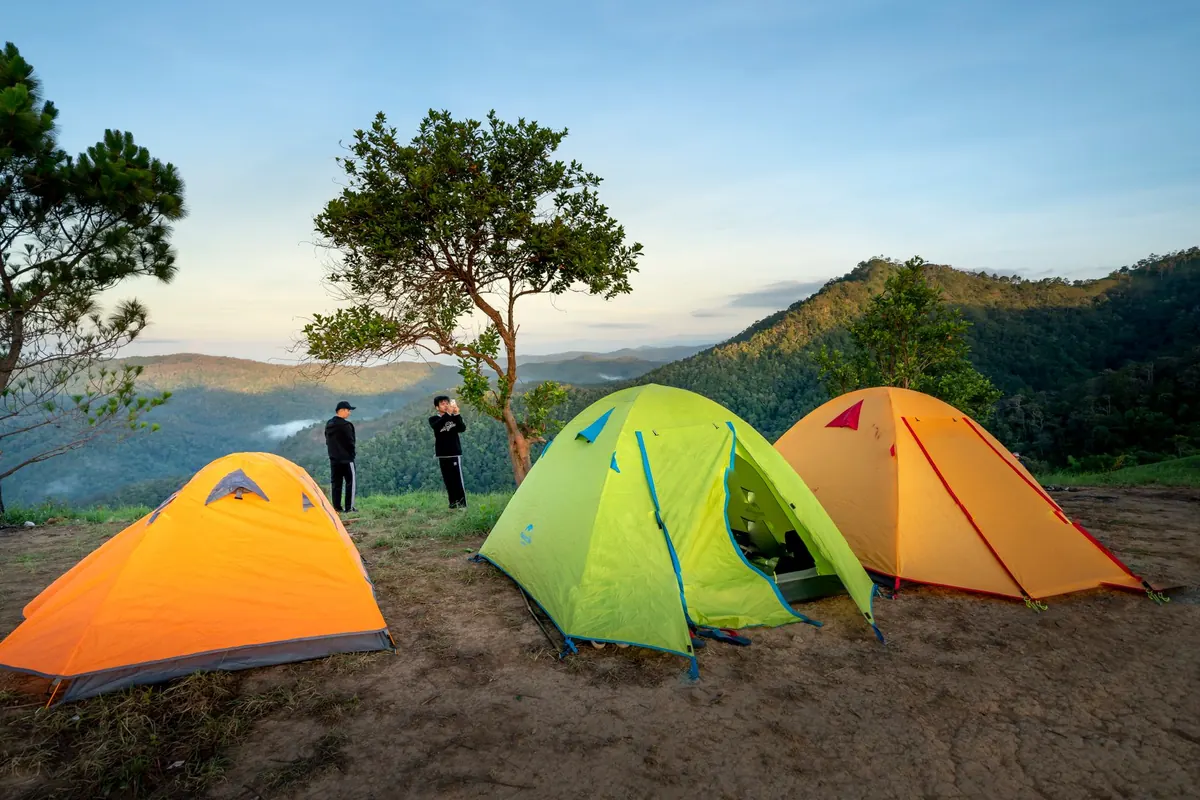
Wild camping means sleeping in a tent somewhere that isn't a campsite: a flat patch behind a drystone wall, a shingle bank above a river, a corner of moorland nobody visits after dark. Done well, it costs nothing and beats any hotel view. Done badly, it ends with a moved-on camper, an annoyed landowner and a scar on the ground that lasts for years.
England and Wales are stricter about it than most people assume, and the good spots sit further from the car park than beginners expect. Here's what the rules actually say, what to carry, how to leave no trace, and how to choose a night when the weather won't overrule your plans.
The legal position, in plain terms
There is no general right to wild camp in England or Wales. The open-access rights that let you walk across much open country do not extend to pitching a tent, and that includes access land, commons and most national park land. On private ground, from farmland to forestry to reservoir catchments, you need the landowner's permission.
Dartmoor is the place most often described as the exception, and the legal position there has shifted in recent years. The national park now runs camping in designated areas on a permissive basis, usually for a small fee and often with booking. Check the current rules before you travel rather than relying on what a forum said three years ago.
In practice you have three sensible routes:
- Ask. A polite request to a farmer, estate office or landowner works more often than people think, particularly outside lambing and harvest.
- Head north. Scotland's access legislation gives a right of responsible access that includes lightweight camping in many places, with local restrictions. Different country, different rules.
- Use a "nearly wild" site. A field with a tap, a compost loo and no other facilities, often a few pounds a night, gets you most of the experience with none of the uncertainty.
Some landowners tolerate quiet backpackers who arrive late, pitch small and leave early. Tolerance is not permission, and it can be withdrawn. This is general guidance rather than legal advice: if a particular spot matters, check with the national park authority or the landowner first.
Choosing a pitch
The pitch matters more than the tent. Look for ground that is flat, well drained and durable: short grass, gravel or bare earth rather than fragile moss or a flowering meadow. Avoid hollows, where cold air and water gather, and avoid pitching under trees, where dead branches fall.
Keep at least 30 metres between your tent and any water, path or building. That protects water quality and keeps you out of sight. Arriving at dusk and leaving at first light is the classic approach: less disturbance, fewer conversations you would rather not have. If the only flat spot is a lump in the ground on open moorland, step around it. It may well be a Bronze Age cairn.
A first wild camping kit list
You don't need much, but you do need the right much. For a single summer night in England or Wales, this covers it:
- Tent: lightweight three-season, double-skinned, around 1.5–2 kg. Pitch it in the garden first.
- Sleeping bag: comfort rating a few degrees below the forecast overnight temperature.
- Sleeping mat: insulation matters more than thickness. A cold mat drains the heat out of you all night.
- Stove and fuel: small gas or alcohol stove. Open fires are banned or strongly discouraged nearly everywhere.
- Water: two litres of capacity, plus a filter or purification tablets for refills.
- Clothing: waterproof jacket and trousers, a warm mid-layer, dry socks kept in a dry bag.
- Navigation: paper map and compass, plus an offline map on a charged phone and a power bank.
- Essentials: headtorch, trowel or wag bag, bin bag for all rubbish, small first aid kit, tick tool, foil blanket and whistle.
- Seasonal extras: midge head net for still summer evenings in the west, sunscreen and a hat for exposed ridges.
Weigh the pack before you leave. If a one-night load tops 12 kg, something in there is a comfort you won't use.
Leave no trace, in practice
The principle is simple: someone should be able to stand where your tent stood and see no sign you were there. The practice takes a bit of discipline.
- Pitch on durable ground, and move on each night rather than returning to the same patch.
- Carry out everything, including food scraps, tea bags and so-called biodegradable wipes. If you carried it in, it goes out.
- For toilet stops, dig a hole 15–20 cm deep and at least 30 metres from water, paths and pitches, then carry the paper out in a bag. Where the soil is thin or the area is busy, use a wag bag instead.
- Wash well away from streams and lakes, and use as little soap as possible.
- Don't light fires. A stove cooks the same meal and leaves nothing behind.
- Give wildlife and livestock space. Close gates, don't feed animals, and keep dogs under control or leave them at home.
Weather, daylight and timing
Two forecasts, every time: one for the valley you'll walk from, one for the high ground. Mountain forecasts give wind speed, cloud base and precipitation, which matter more than the temperature figure. A 40 mph wind on an exposed ridge turns a pleasant evening into a wrestle with the tent; much above that and lightweight poles start to fail. Cloud base tells you whether the walk in will be beautiful or a compass exercise in fog.
Check sunset and work backwards. Be pitched 30 to 45 minutes before dark, which leaves time to sort out water and cook without a headtorch clamped in your teeth. In December, dark can arrive before 4pm in mid-Wales. Assume the ground is wetter than it looks, and treat heavy rain as a planning problem rather than a character test. Avoid river crossings after prolonged rain, don't camp in gorges or on flood plains, and skip exposed ridges when the wind is up.
Safety, without the drama
Tell someone your route, your parking spot and when you expect to be back, and message them when you are. Phone signal is patchy in exactly the places you'll want it. Download offline maps before leaving, carry a power bank, and remember that 999 will use any available network, even one that isn't yours. In England and Wales, mountain rescue is called out through the police: ask for the police, then mountain rescue. If you want the text-to-999 service, register for it at home, not on a hillside.
Ticks deserve respect in long grass and bracken. Check yourself properly each evening and remove them promptly with a proper tool. If you have a medical condition that could affect you on a remote walk, speak to a healthcare professional before you go.
Your first trip
Start small. Pick a permissive site or somewhere you have permission, three or four miles from the car, on a dry forecast, in late spring or early summer. Walk in during the evening, pitch, cook one simple meal, sleep, and walk out after breakfast. You'll learn more about your kit and your own tolerance for discomfort in one night than in a month of reading.
Then adjust: leave behind what you never touched, upgrade the one thing that annoyed you, and choose a wilder spot next time. That is the whole skill, and it builds quickly.
Photo: Quang Nguyen Vinh / Pexels